 |
|
General Description
-- PeterWintz - July-8, 2025 (in progress)The Central Straw Tube Tracker
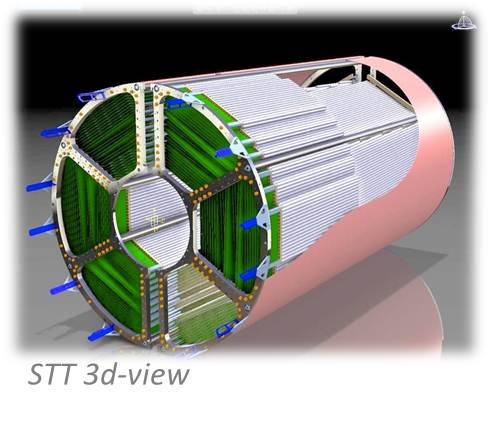
The PANDA Straw Tube Tracker (STT) is the central tracking detector in the PANDA target spectrometer and consists of 4224 single straw tubes, arranged in a large hollow cylindrical volume around the beam-target interaction point. It encloses the Micro-Vertex-Detector (MVD) for the inner tracking and is followed in beam direction by a vertical setup of GEM-disks for adding track points in the forward polar angle range.
Tasks of the STT are the precise spatial reconstruction of the helical trajectories of charged particles in the solenoidal magnetic field and deducing the particle momentum with a high resolution of 1-2% together with the MVD information. In addition, the particle-specific energy-loss in the straw gas is measured for particle identification (PID) and to separate protons, kaons and pions in the momentum region below 1 GeV /c. A large variety of particle species in a broad momentum range from about a few 100 MeV /c up to 8 GeV /c have to be measured by the STT and with particle rates up to 1 MHz per straw for the innermost STT layers at the PANDA full luminosity of 2×1032 cm2/s and 2×10⁷ s-1 antiproton interaction rate. The STT is essential for the online track reconstruction and tracks to event association in the PANDA specific environment of about 150 tracks from 40 individual events within 2 µs.
 | |
| Fig. 1: Straw components. |
The STT design is optimised for a minimal material budget by minimising the number and thickness of all straw components. The low total material budget in radial direction of only 1.23 % in radiation length is achieved by the innovative technique of self-supporting straw layer modules by the inner gas overpressure, which avoids stretching of the tubes and wires by a mechanical frame or reinforcement structures. The 4224 straw tubes, each with a length of 1400 mm, 10 mm inner diameter and 27 µm wall thickness of aluminised mylar film, are pressurized to 1 bar overpressure (2 bar absolute pressure). The straws are glued together to close-packed, self-supporting multi-layers which sustain the wire tension and tube stretching equivalent to 211 kg and 3.3 tons, respectively (stretching weight and total sum).
The cylindrical volume of the STT has an inner and outer radius of 150 mm and 420 mm respectively. The total length is 1650 mm including the front-end mounted readout electronic cards, cabling and supply lines for voltage and gas. The STT is split into two semi-cylinders, which are mounted each on one side of a vertical support frame structure with a width of 50 mm for the imbedded vertical target pipe.
 |  | ||
| Fig. 2: STT 3D-view. | Fig. 4: STT semi-cylinder mockup. |
| STT Dimension | |
|---|---|
| Inner radius | 150 mm |
| Outer radius | 420 mm |
| Total length | 1650 mm |
| Straw length | 1400 mm |
| Vertical gap | 50 mm |
| Material budget (radial) | 1.23 % (X/X0) |
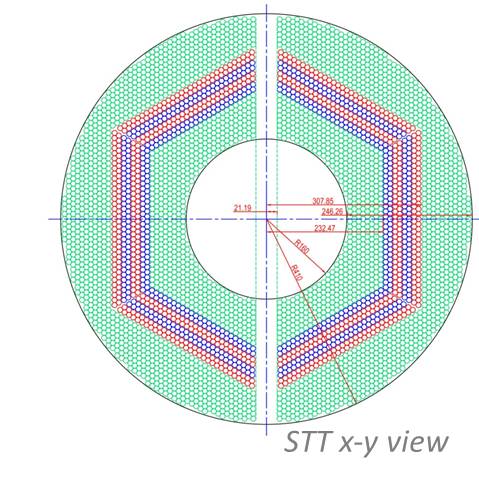
The straw layout in the STT consists of close-packed straw layers in axial direction parallel to the beam and magnetic field for the track reconstruction in the the rφ-plane and stereo double-layers with slightly (±3°) skewed straw orientation for a full trajectory reconstruction in 3D-space. The electronic readout chain consists of the PANDA straw-specific PASTTREC ASIC (design by AGH Krakow) with a charge sensitive amplifier, signal shaper and leading edge discriminator. The signal leading edge (LE) and trailing edge (TE) times are readout by a TDC system (TRB3/5, design by GSI). The signal LE-time is used to determine the drift times (t) and corresponding isochrone circles r(t) in the hit straws for the spatial track reconstruction and the time-over-threshold (=TE-LE times) is used for the particle-specific energy loss (dE/dx) measurement for PID.
  |  | |
| Fig. 3: Cross-section view with axial oriented straws marked in green and the skewed straw double-layers in blue (+3°) and red (-3°). | Fig. 9: Simulation of four muon tracks with hit straws, measured drift times (isochrone circles r(t)) and reconstructed trajectories in the STT (left). Measured isochrone circles r(t) and fitted trajectories for two tracks (right), |
A dedicated in-beam test campaign with an STT prototype, consisting of eight close packed layers, each with 24 straws, was carried out at the COSY accelerator (FZ Jülich). The proton and deuteron beams in the momentum range from about 0.5 GeV /c to 3 GeV /c were used to determine the spatial resolution in the track reconstruction and verify the time-over-threshold (TOT) information used for PID. A spatial single hit resolution better than 130µm was obtained (design goal 150 µm). The TOT/dx information showed a clean 1/β2 dependence with the particle momentum which will be used for PID.
 |  | ||
| Fig. 5: Spatial single hit resolutions obtained in the in-beam test campaign at COSY over the full accessible momentum range. A result of better than 130 µm was obtained (design goal: 150 µm). | Fig. 6: Time-over-threshold (ToT) measurement with the STT to be used for PID. The ToT /dx showed the expected dependence 1/β2 of the particle-specific energy-loss. |
Specifications | |
|---|---|
| STT inner radius | 150 mm |
| STT outer radius | 420 mm |
| STT length | 1650 mm |
| Vertical target pipe gap | 50 mm |
| Material budget (radial) | 1.23 % (X/X0) |
| Number of straws | 4224 |
| Straw length | 1400 mm |
| Straw diameter (inner) | 10 mm |
| Straw pitch | 10.14 mm |
| Straw film tube | Mylar, Al coating |
| Straw wall thickness | 27 µm |
| Sense wire | W/Re (97/3), Au-plated |
| Wire diameter | 20 µm |
| Number of axial layers | 15-19 |
| Number of stereo layers | 8 |
| Stereo angle | ±3 ° |
| Gas mixture | Ar/CO2 (90/10) |
| Gas pressure | 2 bar (abs.) |
| Straw transparency (X/X0) | 4.5×10⁻⁴ |
| Maximum drift time (2T-field) | ~ 200 ns |
| Spatial rφ-resolution | < 150 µm |
| Spatial z-resolution | 2-3 mm |
| Energy resolution (dE/dx) | < 10 % |
| Maximum straw rate (innermost layer) | 1 MHz, 7-14 kHz/cm |
| Mean charge load (per year) | 0.2 C/cm |
References:
- STT Technical Design Report, https://doi.org/10.1140/epja/i2013-13025-8
- Front-end electronics for STT in HADES and PANDA, https://doi.org/10.1088/1748-0221/18/05/P05008
Back to STT.WebHome


| I | Attachment | Action | Size | Date | Who | Comment |
|---|---|---|---|---|---|---|
 jpg jpg |
STT_3Dview.jpg | manage | 30 K | 2013-11-04 - 15:16 | PeterWintz | STT 3-D view |
| jpg |
STT_xyview.jpg | manage | 52 K | 2013-11-04 - 15:14 | PeterWintz | STT x-y view |
| jpg |
fig1.jpg | manage | 177 K | 2025-07-08 - 12:32 | PeterWintz | |
| jpg |
fig2.jpg | manage | 170 K | 2025-07-08 - 12:44 | PeterWintz | |
| jpg |
fig3.jpg | manage | 312 K | 2025-07-08 - 14:51 | PeterWintz | |
| jpg |
fig4.jpg | manage | 201 K | 2025-07-08 - 14:51 | PeterWintz | |
| jpg |
fig5.jpg | manage | 105 K | 2025-07-08 - 14:52 | PeterWintz | |
| jpg |
fig6.jpg | manage | 98 K | 2025-07-08 - 15:13 | PeterWintz | |
 PNG PNG |
fig9.PNG | manage | 190 K | 2025-07-08 - 15:15 | PeterWintz |



Web Home | Search Changes | Notifications Index | Topics
- Webs
- Cerenkov * Cerenkov.Pandacerenkov * DCS * Daq * Daq.Pandadaq * Detector * EMC * EMPAnalysis * Forwardstraws * GEM * MC * Magnet * Main * Mvd * PANDAMainz * PWA * Pbook * Personalpages * Physics * Physics.Baryons * Physics.CharmoniumAndExotics * Physics.HadronsInNuclei * Physics.OpenCharm * PhysicsCmt * SPC * STT * Sandbox * ScrutinyGroup * Tagpid * Tagpid.Pandatagpid * Tagtrk * Tagtrk.Pandatagtrk * Target * Target.ClusterJetTarget * Tof * WebServices * YoungScientists * ZArchives
Ideas, requests, problems regarding Panda Wiki Send feedback | Imprint | Privacy Policy (in German)